How can AI help academic and administrative staff save time, make research and teaching more efficient, and work securely with university data?
Artificial intelligence is already being used at universities today—in lesson preparation, working with academic texts, administrative tasks, communicating with students, and research activities.
The question, therefore, is less and less whether universities will use AI. What’s more important is how to use it systematically, securely, and with measurable benefits.
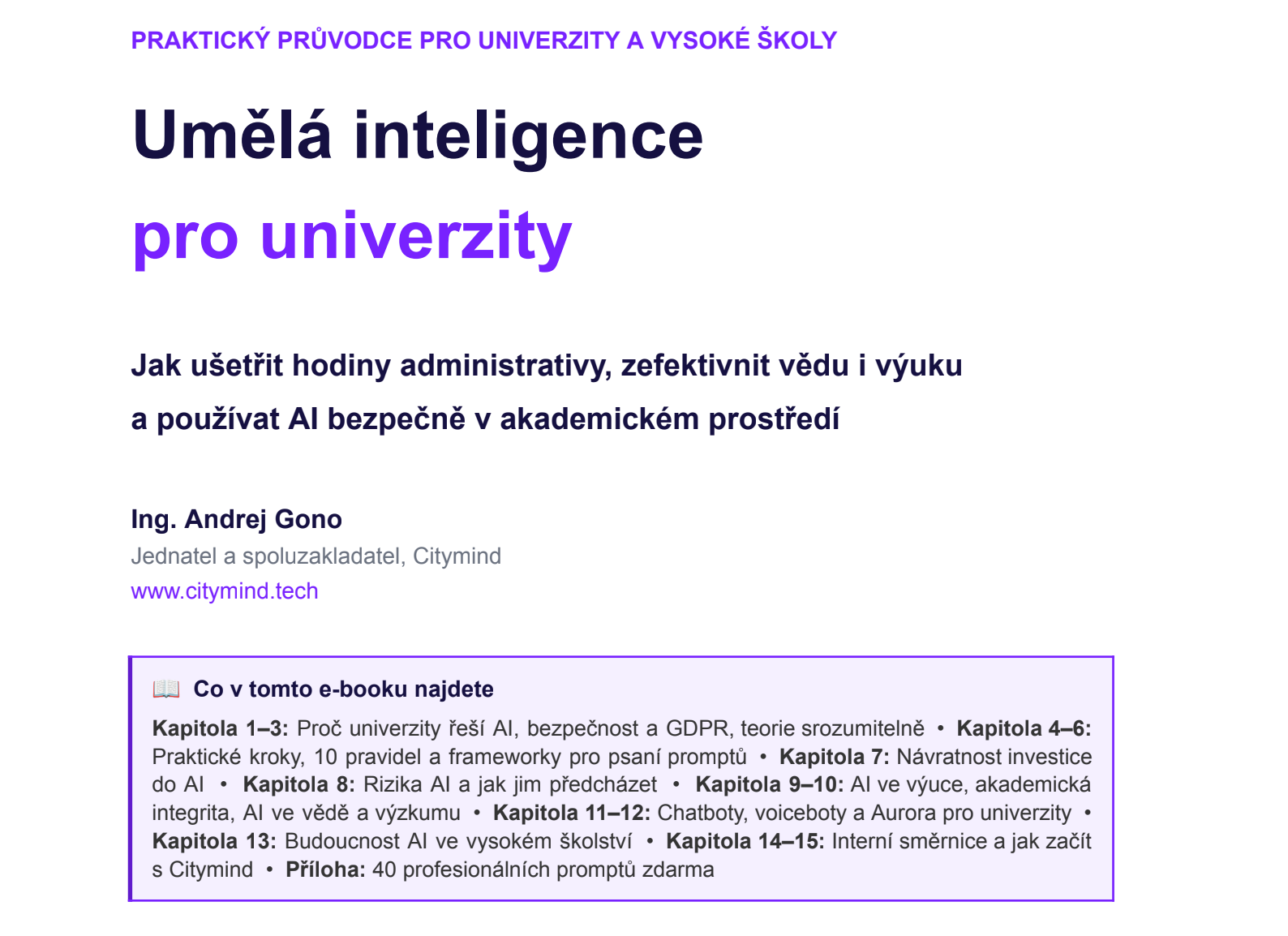
This is precisely the focus of Citymind’s new e-book, Artificial Intelligence for Universities.
What You’ll Find in the E-book
- Where AI Can Save the Most Time for Academic and Administrative Staff
- Data security, GDPR, and specific AI risks in the academic environment
- A practical overview of the main AI tools
- A step-by-step guide to implementing AI at a college or university
- 10 basic rules for working effectively with AI
- RACEF, CO-STAR, CLEAR frameworks, and other prompting techniques
- Model calculation of return on investment in AI
- AI in Teaching and Issues of Academic Integrity
- AI in Science and Research
- Using chatbots and voicebots to communicate with students and applicants
- Internal AI assistants for university administration
- Drafting Rules and Internal Guidelines for Working with AI
- 40 Ready-to-Use Professional Prompts for Universities
The e-book includes specific examples for the rector’s office, deans’ offices, departments, academic and grant offices, researchers, as well as PR and IT teams.
For example, in a model case study, it examines a faculty with 200 employees, where a 25% reduction in administrative work results in potential savings of approximately 11.8 million CZK per year and a model return on investment of roughly 12:1.